
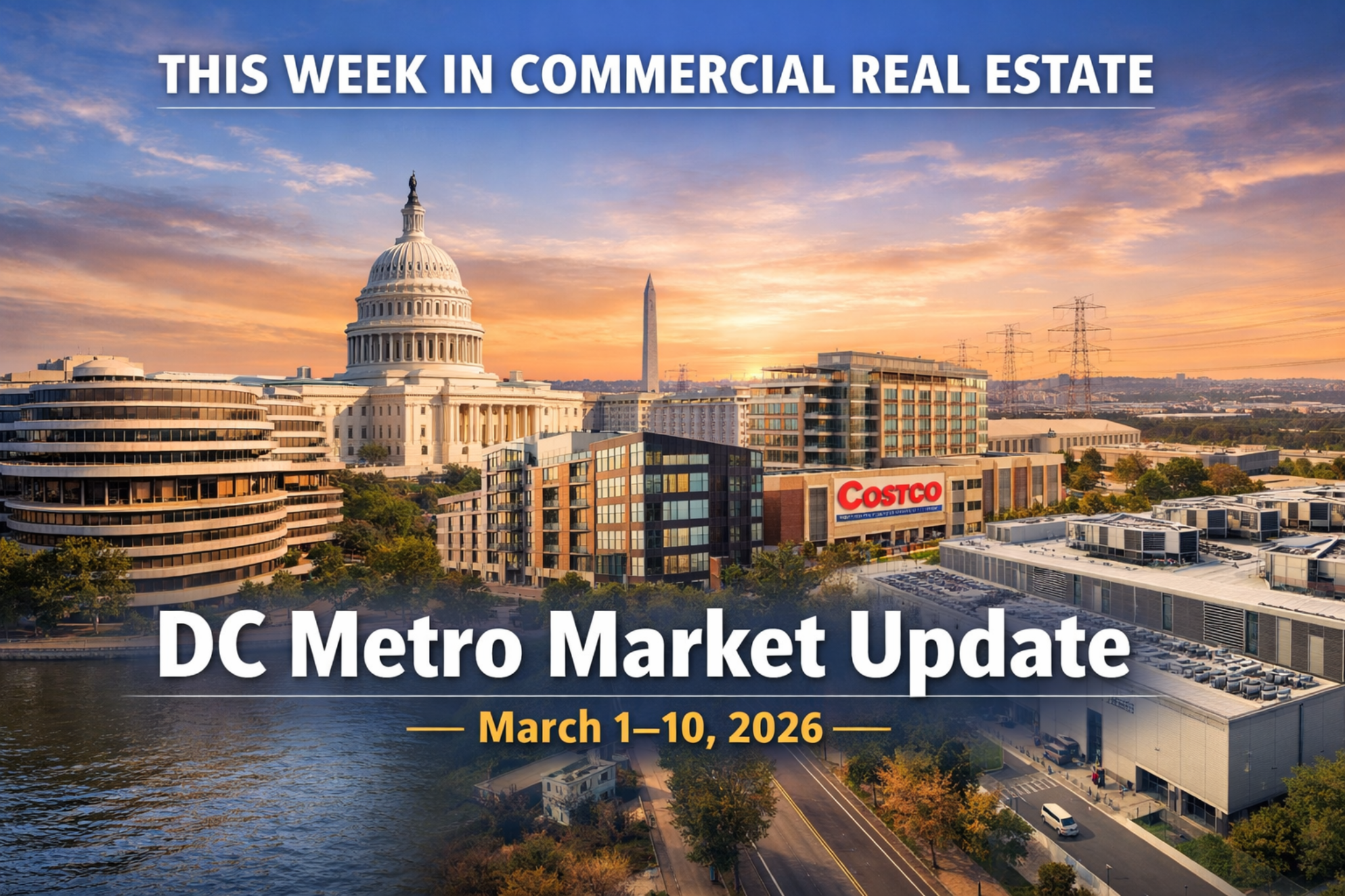
This Week in Commercial Real Estate: DC Metro Market Update (March 1–10, 2026)
This Week in Commercial Real Estate: DC Metro Market Update (March 1–10, 2026)
The Washington, DC commercial real estate market continues to evolve as investors, developers, and tenants respond to shifting demand across office, residential, retail, and digital infrastructure. During the first ten days of March, the region saw continued repricing of older office assets, accelerating office-to-residential conversions, major mixed-use development activity, and sustained investment tied to Northern Virginia’s data center economy.
Together, these developments highlight how the DC metro market is actively reshaping itself around where demand is strongest. Industry data from firms such as CBRE Research and Bisnow Washington DC continues to show that high-quality locations, mixed-use environments, and transit-connected corridors remain the most resilient parts of the region’s commercial real estate landscape.
Office Repricing Continues Across Washington DC
One of the clearest signals of the office market reset came with the recent sale of an office building in the Watergate complex. The transaction reflected the broader recalibration underway in Washington’s office sector, where older properties without modern amenities are seeing pricing adjust after years of elevated valuations.
Rather than signaling declining interest in the District, this repricing reflects a more selective market. Tenants increasingly prioritize buildings with updated infrastructure, flexible layouts, and access to vibrant neighborhoods. As a result, retail corridors located within established business districts and walkable neighborhoods continue to attract tenant interest.
Prime retail corridors such as Georgetown and downtown Washington remain highly desirable for retailers seeking visibility and foot traffic. Locations like 2715 M Street NW, 2900 M Street NW, and 1440 Wisconsin Avenue NW continue to represent some of the most recognizable retail corridors in Georgetown.
Downtown locations also remain attractive for retail and service users serving office workers and visitors. Opportunities such as 700 14th Street NW, 717 14th Street NW, 2033 K Street NW, and 1432 K Street NW illustrate how strong urban locations continue to anchor retail demand.
Office-to-Residential Conversions Accelerate
Another major theme shaping the DC metro market is the increasing number of office-to-residential conversion projects. Across the region, developers are repositioning older office buildings to meet the persistent demand for housing in transit-accessible, job-rich neighborhoods.
In Arlington’s Pentagon City neighborhood, plans are moving forward to convert a former federal office building into hundreds of residential units. Projects like this are becoming increasingly common as developers look to unlock value from underutilized office properties while helping address regional housing demand.
These conversions also benefit surrounding retail corridors by increasing neighborhood population and daily foot traffic. Retail spaces located within walkable mixed-use environments often benefit from the steady demand created by residential density.
Locations such as 2130 P Street NW, 1666 Connecticut Avenue NW, and 1140 Connecticut Avenue NW demonstrate how retail spaces embedded within residential and office neighborhoods can benefit from these evolving land-use patterns.
Mixed-Use Development Continues to Expand
Mixed-use development remains one of the strongest growth stories across the DC metro area. In Montgomery County, a major development project recently secured a large anchor retailer as part of a multi-billion-dollar mixed-use plan that will include thousands of residential units along with retail, hospitality, and office space.
Projects like this reflect a broader shift toward walkable environments where people can live, work, shop, and socialize within the same neighborhood. Retail spaces located in these environments tend to outperform isolated retail locations because they benefit from consistent daily activity.
Within Washington, several high-profile mixed-use properties continue to offer retail opportunities connected to major employment centers and tourism traffic. These include locations such as 555 13th Street NW, 1001 Pennsylvania Avenue NW, 1750 Pennsylvania Avenue NW, and 1401 Pennsylvania Avenue NW.
Capitol Hill also continues to see strong demand for neighborhood retail serving residents and visitors alike. A good example is 637 Pennsylvania Avenue SE, located along one of the most recognizable retail corridors on Capitol Hill.
Northern Virginia’s Data Center Boom Continues
While Washington DC itself continues to adapt to shifting office demand, Northern Virginia remains one of the fastest-growing commercial real estate markets in the country thanks to the global expansion of data infrastructure.
A major transaction involving George Washington University’s Virginia Science and Technology campus in Ashburn highlighted the ongoing demand for land suitable for data center development. The property was acquired for redevelopment into a digital infrastructure campus, reinforcing Loudoun County’s role as one of the most important data center markets in the world.
At the same time, the rapid expansion of data centers has also sparked discussions about land use, infrastructure capacity, and environmental impact. Local reporting from outlets such as FFXNow has highlighted debates surrounding potential land sales and rezoning efforts tied to new data center proposals in Northern Virginia.
Despite those debates, the broader trend remains clear: Northern Virginia continues to attract massive global investment due to its proximity to Washington DC, strong fiber infrastructure, and established data center ecosystem. Industry coverage from publications like Reuters and Commercial Observer has repeatedly emphasized the region’s dominance in digital infrastructure development.
What This Means for the DC Metro CRE Market
The developments between March 1 and March 10 reinforce that the DC metro commercial real estate market is evolving rather than slowing down. Older office buildings are being repriced or repositioned, mixed-use environments are expanding, and new investment continues to flow into technology infrastructure and residential development.
For retailers, investors, and property owners, the most resilient opportunities remain tied to strong locations, walkable neighborhoods, and mixed-use districts that support consistent activity throughout the day.
To explore available retail opportunities across the District, visit Miller Walker’s Washington DC retail listings.